Mrs Frances Abington
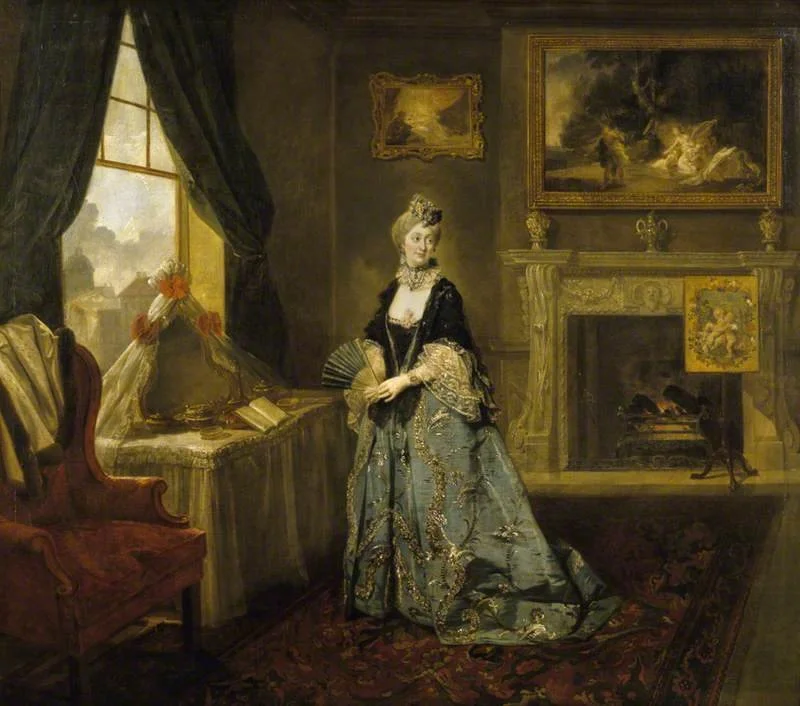
Frances Barton, Mrs Abington (1737-1815) as The Widow Belmour in Arthur Murphy’s The Way to Keep Him
Painted by Johan Zoffany, RA, (1733-1810)
This portrait is part of the National Trust’s collection and hangs at Petworth House, West Sussex, UK. Playing the Widow Belmour brought Abington to the attention of the London audience and occasioned the first surviving portrait of her, painted by one of Garrick’s favoured artists, Johan Zoffany (1733-1810). It is a very conventional pose, in a similar style to his portraits of Garrick. The setting has been expanded to lose all sense of painted stage flats and wings, and the figure has been frozen as if in mid-speech. In this sense it is similar to many of Zoffany’s portraits of Garrick, although the nature of comedy allows Abington to take a more relaxed and natural pose.
The actress, in her role as the widow is shown in her boudoir, a fashionable well-furnished room. There is an elaborate marble fireplace with a painting depicting a classical myth above, and a rich carpet on the floor. The main piece of furniture is her dressing table, draped with gauze and ribbons. Zoffany’s depiction is reminiscent of the one in his recent painting of Queen Charlotte with her sons, making it a very fashionable object. The items for the Widow’s toilette ranged on the table, also echo those of Queen Charlotte, but the Widow has placed her book on top of them, suggesting that intellectual pursuits hold more interest for her.
Zoffany was moving in aristocratic circles, and in this image, he has elevated Abington above the class of actor to place her among the fashionable set, a facility she was to employ from other artists in the future, especially Sir Joshua Reynolds (1723-1792).
We can imagine a conversation between the artist and his sitter, who may have had decided opinions on what she should wear. Abington is dressed in a fashionable and beautiful turquoise silk mantua with silver embroidery and robings, with a matching skirt. The stomacher is black and she wears a black lace shawl over her shoulders, adding a sense of mourning to the ensemble. The small, decorated cap on her neatly dressed hair, with a lace frill and jewelled band at her neck serve to frame her face. The way in which her hair has been dressed would prove to be her favoured style for portraits, even when high wigs became the fashion later in her career. Draped on the back of a comfortable chair is a satin cape trimmed with fur. Everything in the picture points towards the character depicted as a well-off, sophisticated and highly fashionable woman.
This is the first of many images created of Abington over her career as she took the opportunity to take some control and present herself to the public beyond the confines of the stage. Later, as she grew in confidence and began to her association with Joshua Reynolds, she would use her portraits to challenge this straightforward view of her as an actress.